HISTORY
Inspired by the wisdom of Kuan Zi, we believe that education is a noble endeavor that must always be upheld. Prof. Dr. Nicolaus Driyarkara (1913–1967), a renowned Indonesian educator and religious figure, once said that education is the act of humanizing young humans. Through education, one becomes a complete person—a cultured human being. This responsibility begins with parents, as the family is the first place where children are given the opportunity to live, grow, and find their role. For the sake of their children’s future, parents entrust schools to help educate them. David Emile Durkheim (1858–1917), a prominent sociologist, emphasized that schools are the most suitable moral institutions: “Schools serve as the ideal bridge between the moral state of children leaving their families and the moral state they must strive to attain.”
Puhua School, also known as Sekolah 3 Bahasa Putera Harapan, celebrates its founding anniversary on April 30. Since its inception, Puhua has grown into one of Purwokerto’s most respected educational institutions. The journey began in 1850 when Tan Swie Sing, a migrant from southern China, settled in Purwokerto. His sincere personality and passion for teaching Chinese to children earned him the affectionate title “Shi Ye.”
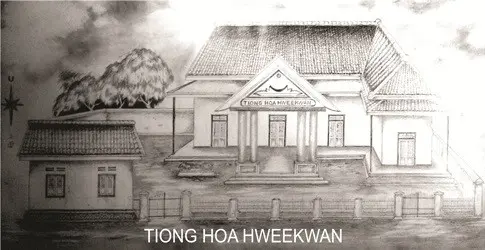
His eldest son, Tan Hay Siang, continued his father’s legacy by establishing a school with three classrooms in Sokaraja. In 1905–1906, Kho Han Lie donated land for the school, leading to the founding of “Sekolah Tiong Hoa Hwee Kwan” on February 6, 1906—the foundation of what would become Puhua School.
Education at Sekolah THHK continued to flourish. In 1947, the school began offering junior high education and officially adopted the name “Sekolah Tionghoa Purwokerto – Pu Hua.” By 1949, the school celebrated its first graduating class.
Despite its success, the school faced challenges. In 1957, the government prohibited Chinese schools from accepting Indonesian citizens (WNI) and barred WNI teachers from teaching at Pu Hua. In 1958, the school was nationalized and split into two: one for foreign nationals (WNA) and another for Indonesian students as a national school.
A turning point came in 1959 when Puhua’s elementary and junior high divisions moved into a new building. Students from surrounding areas began enrolling. In 1963, Puhua applied to open a senior high school, but by April 30, 1966, all Puhua schools were closed. Students lost access to Mandarin education, and teachers faced unemployment and economic hardship. During the New Order era, Chinese education stagnated, and anti-Chinese sentiment grew. Many Chinese families in Purwokerto felt pressured to abandon Mandarin learning.
Nevertheless, Mandarin instruction continued in secret. Former Puhua students united to study Mandarin privately at home. Advanced learners taught their peers, and this informal education persisted into the 1970s.
In 1988, the first alumni reunion was held, known as the “First Chinese Friendship Conference.” The second conference followed in 1992, themed “Welcoming Christmas and New Year 1992,” attended by 49 former teachers and hundreds of alumni. In 1996, the Paguyuban Pengusaha Banyumas (Banyumas Entrepreneurs Association) was founded, and on December 3, 1997, the Putera Harapan Foundation was officially established.
Puhua’s development continued. In 2000, construction began on the foundation’s new building. In 2001, the foundation launched Mandarin language courses through LPK Putera Harapan. That same year, a “Beijing Tour” was organized to honor former teachers. In 2003, TK Nasional Putera Harapan (National Kindergarten) was established. In 2004, the foundation supported Universitas Jenderal Soedirman in launching a Mandarin diploma program. On April 30, 2006, the cornerstone was laid for the new campus of Sekolah Nasional 3 Bahasa Putera Harapan. The school has continued to grow ever since.
From the beginning, Puhua School has been the first national trilingual school in Purwokerto. Its educational approach combines language mastery with character and mental development, shaping students into kind, refined, and virtuous individuals. Guided by the motto “diligent, sincere, humble, and persevering,” Puhua strives to be a school recognized by the wider community and committed to producing high-quality graduates.